Machine reasoning is no longer a research demo
A year or two ago, most “reasoning” demos still felt like carefully staged puzzles: impressive, but fragile outside the lab. That’s changed because the same models are now being used inside everyday tools—support copilots, analytics assistants, coding helpers—and they hold up often enough that teams can justify putting them in real workflows. The shift isn’t that machines suddenly think like people; it’s that they can carry a multi-step goal across messy inputs, keep intermediate constraints in mind, and produce usable output more frequently.
At the same time, “works in production” comes with costs and guardrails. Latency, token spend, and review time rise quickly when you ask for deeper step-by-step work, and reliability still depends heavily on how the task is framed and verified. The practical question moved from “can it solve this?” to “can it do this repeatedly, under real data, with acceptable risk?”
What people mean by “reasoning” in real deployments
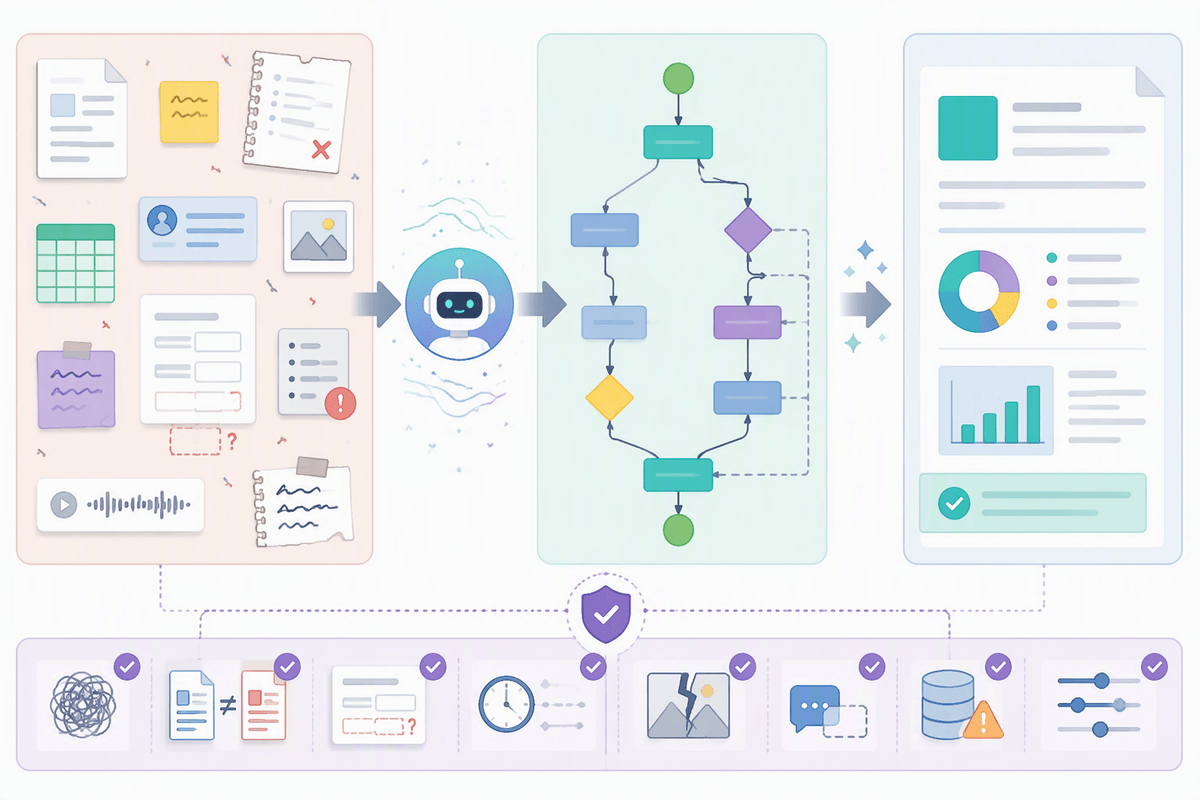
In real deployments, “reasoning” usually means something less philosophical and more operational: the model can take a goal like “explain the revenue dip,” pull relevant signals from a noisy brief, form a plan, and produce an answer that matches constraints (time range, definitions, sources, tone) without drifting. Teams also use the word to mean basic robustness—handling missing fields, conflicting notes, or edge cases without collapsing into generic filler.
It also shows up as tool use: deciding which query to run, what code to write, what to ask the user, and how to reconcile results into a recommendation. The tell is not eloquent explanations, but fewer “silent failures” where the output looks plausible yet violates a key requirement. Even then, this capability is uneven: long contexts, ambiguous policies, and hidden assumptions can still trigger confident mistakes, so “reasoning” in practice often includes a verification step and clear stop conditions.
Why expectations jumped: capabilities that compound quickly
You can feel the jump in expectations when you watch a model handle not one improvement, but a stack of them in the same session. Slightly better instruction-following means it stays on the metric definition. Slightly better long-context handling means it notices the footnote that changes the conclusion. Slightly better tool use means it runs the right query or writes a quick script instead of guessing. When those land together, a workflow that used to require three people and a checklist can look like one prompt and a decent first draft.
The compounding effect also makes demos more convincing: planning, execution, and explanation happen in one smooth pass, so it feels like “reasoning” arrived all at once. In practice, the same stack increases cost. More context, more tool calls, and more retries raise latency and token spend, and the gains can vanish if your data is messy, your tools return surprising results, or nobody is accountable for checking the final claim.
Where the new reasoning breaks down in surprising ways
You see the cracks when the work stops looking like a puzzle and starts looking like an inbox. The model may plan well, but a single wrong assumption can quietly infect every later step: it uses the wrong definition of “active user,” treats a partial export as complete, or assumes a policy exception that isn’t stated. Because the writing stays coherent, teams often miss the moment the reasoning went off the rails. Another common surprise is “constraint slippage” in long threads: it acknowledges a requirement (“don’t use PII,” “only use last quarter”) and then violates it 20 lines later after a tool call or a reframing.
Tool use adds its own failure modes. A model can run the right query and still misread a column, ignore a NULL-heavy segment, or merge two tables incorrectly while sounding confident. When the environment is dynamic—rate limits, flaky APIs, changing dashboards—retries and fallbacks can create inconsistent results that are hard to reproduce. The practical constraint is that better reasoning often means more steps, and more steps mean more surface area for subtle, expensive-to-detect mistakes unless you build in checks.
Choosing the right benchmark: from puzzles to work tasks

A common trap is treating a clean benchmark score like a promise of workplace reliability. Puzzle-style tests reward short, self-contained logic where the rules are complete and the “ground truth” is obvious. Your work tasks rarely look like that. They involve incomplete briefs, shifting definitions, and dependencies on tools and data that can be wrong, delayed, or permissioned. If you benchmark only with riddles, you’ll select for models that sound sharp in isolation but fail quietly when the job is “figure out what’s missing, then ask or check.”
A better benchmark is a thin slice of your real workflow: the same inputs, the same constraints, the same tools, and a graded outcome that includes process errors. Track whether it asked the right clarifying question, used the right metric definition, cited the right source, and stopped when evidence was insufficient. This costs more to run—real data access, labeling, and human review—but it buys a signal you can actually ship against.
Design patterns that make reasoning dependable enough to ship
A familiar pattern in teams that ship these systems is treating the model like a strong junior analyst: give it structure, narrow its degrees of freedom, and require it to show its work in machine-checkable ways. Instead of one giant prompt, split the job into stages—interpret the request, pick tools, run them, then draft—so you can validate each step and stop early when inputs are missing. In user-facing flows, force clarification up front (“Which definition of active user?”) rather than letting the model guess and bury the guess inside a polished answer.
Reliability improves most when you make correctness cheaper than confidence. Constrain outputs with templates (tables, JSON, required citations), and add lightweight validators: schema checks, unit tests for generated code, reconciliation rules (totals must match), and “no evidence, no claim” gates that trigger a handoff instead of a hallucinated explanation. Use retrieval as a default, but log what was retrieved and what was ignored.
The practical cost is real: more steps mean more latency, more tool calls, and more review surface. The failures become visible and repeatable, which is what turns “reasoning” from a demo into an operational capability.
A practical way to reset expectations without slowing progress
You can reset expectations by rewriting “can it reason?” into a service-level question: what error types are acceptable, how often, and how quickly do you detect them. Treat every deployment as an experiment with a scoreboard—claim accuracy, constraint adherence, tool correctness, and “asked a clarifying question when needed”—and publish the numbers next to cost and latency. That shifts debates from vibes to trade-offs.
Then design for graceful failure. Require citations or computed artifacts for any material claim, and make “I can’t verify” a valid outcome with a clear handoff path. The constraint is that this feels slower at first: more evaluation work, more instrumentation, and occasional user friction. The payoff is sustained progress because improvements are measured in fewer silent failures, not better demos.