Basics Theory
Ten Uncomfortable Ideas That Challenge Common AI Assumptions
Explore 10 uncomfortable ideas that challenge common AI assumptions in health apps: data myths, fluent chatbots, feedback loops, bias, alignment and accountability.
Tessa Rodriguez
Advertisement
Recommended Reading

Applications
User Needs Should Guide Which AI Features Companies Build
Learn how to build AI features that users adopt by starting with real user jobs, prioritizing safe leverage, and designing for trust, verification, and recovery.

Impact
Technology Hype Can Make Generative AI Progress Harder to Evaluate Clearly
Learn how generative AI hype distorts progress claims—and how to evaluate models using reliability, benchmarks vs. real work, edge cases, and true costs.

Impact
The AI Industry Bubble Shapes How Technology Is Discussed
How the AI industry bubble changes tech talk into speculation—winner narratives, hype vocabulary, and shortcuts—plus a checklist to judge real performance and costs.

Impact
High User Expectations Can Expose the Limits of Generative AI Products
High user expectations expose generative AI reliability limits—how inconsistency, context gaps, and tone errors break workflows and erode trust.
Applications
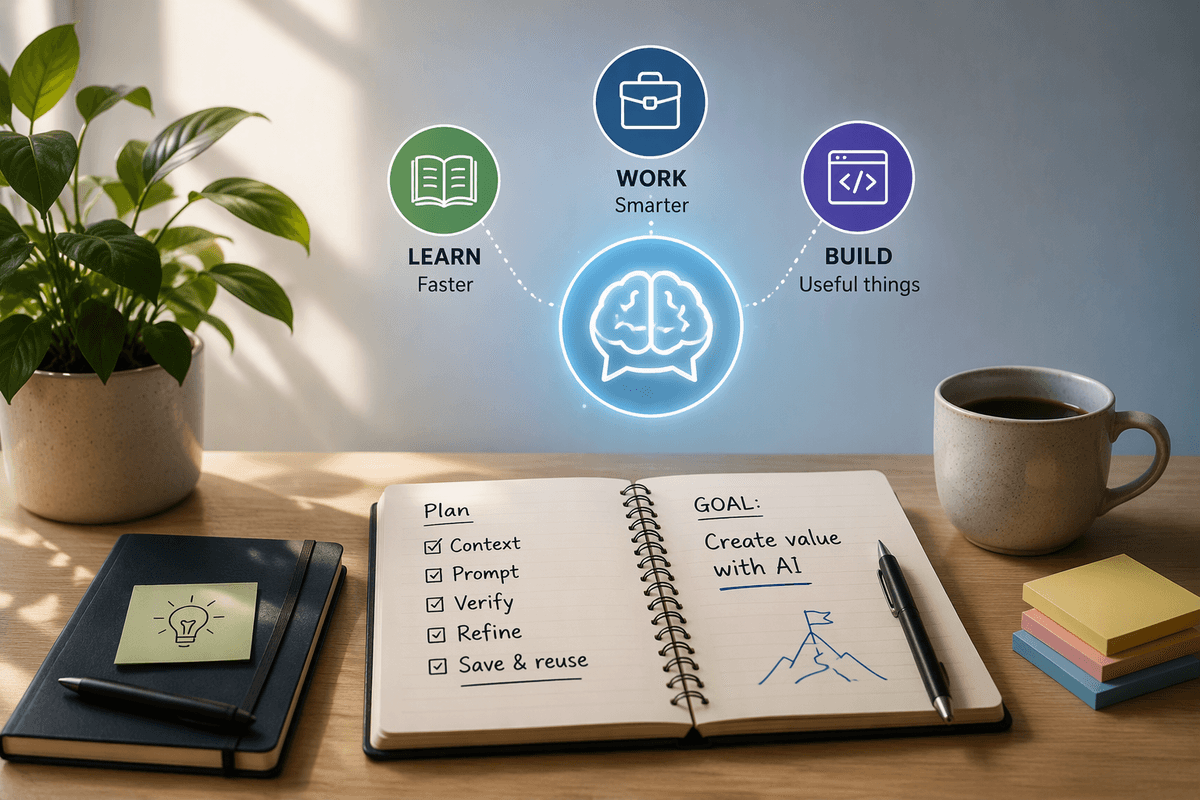
Start With Practical AI Skills for Learning, Work, and Building
Learn practical AI skills: prompt with context, verify outputs, and build simple workflows to study faster, write better, run meetings, and avoid privacy traps.

Impact
Competition Between AI Platforms Can Accelerate New Model Development
How AI platform rivalry accelerates new model development through tooling, telemetry, infrastructure, and ecosystem pull—while increasing lock-in, safety, and fragmentation risks.

Basics Theory
Ten Uncomfortable Ideas That Challenge Common AI Assumptions
Explore 10 uncomfortable ideas that challenge common AI assumptions in health apps: data myths, fluent chatbots, feedback loops, bias, alignment and accountability.

Impact
AI Literacy Matters More Than Knowing Every New AI Tool
AI literacy beats chasing every new AI tool: learn prompts, evaluation, and judgment, plus privacy/IP limits, to use AI reliably at work.

Applications
AI Assistants and Robotics Are Bringing Language Models Into Physical Tasks
Learn how language models power robotics: turning intent into plans, using tools/APIs safely, improving reliability, evaluation, and real-world deployment.

Technologies
Leading AI Models Can Reach Similar Performance in Different Ways
Learn why top AI models can score similarly on benchmarks yet differ in data, architecture, alignment, latency, cost, and reliability—and how to choose the right one.

Impact
AI Copyright Questions Extend From Training Data to Generated Content
Explore AI copyright questions from training data to AI-generated content: what counts as copying, output similarity, ownership, and practical risk checks.

Technologies
Sensitive Questions Require More Than a Simple Chatbot Answer
Learn why sensitive questions break normal chatbot expectations and how to design safer AI: boundaries, triage, human escalation, privacy, and monitoring.